CAPSTONE
CAPSTONE was a Rocket Lab Electron mission for NASA that launched successfully at 09:55 UTC on 28 June 2022 (9:55 p.m. NZST on 28 June; 5:55 a.m. EDT on 28 June) from Launch Complex 1B on New Zealand's Mahia Peninsula.
09:55 UTC on 28 June 2022 · 9:55 p.m. NZST on 28 June · 5:55 a.m. EDT on 28 June
Disclaimer: This livestream is from a third-party channel and is not an official Rocket Lab broadcast.
Mission State
This mission currently has a dated launch window in the tracker.
The current watch link is from a third-party source rather than Rocket Lab directly.
Launch Updates
-
Successful Electron launch. Photon's HyperCurie engine will perform apogee raising burns around every 24 hours for five days, before a final burn on the sixth day to set CAPSTONE on a trans lunar injection
by Nosu Source: twitter.com -
Liftoff
by Nosu Source: youtube.com -
Webcast live
by Nosu Source: youtube.com
Updates via Launch Library 2 (The Space Devs).
Name Origin
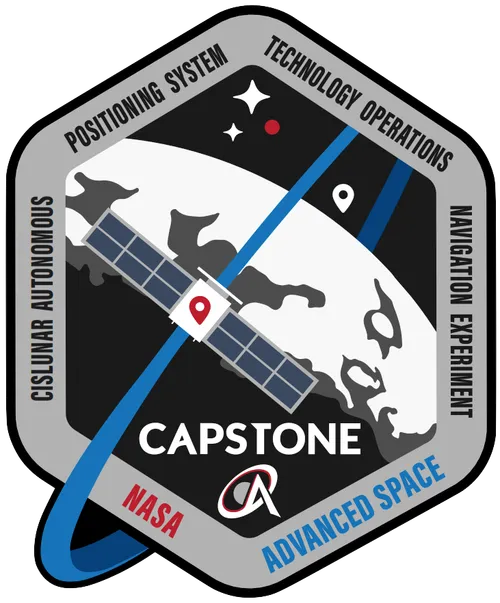
The CAPSTONE mission, named for NASA's Cislunar Autonomous Positioning System Technology Operations and Navigation Experiment, tests navigation and communication technologies for future lunar missions in a unique orbit around the Moon.
Mission Overview
CAPSTONE (Cislunar Autonomous Positioning System Technology Operations and Navigation Experiment) is a 12-U cubesat mission to test operations in near rectiliniar halo orbit around the Moon, which is to be used for the Lunar Gateway space station. Mission will verify the near rectilinear halo orbit characteristics, spacecraft-to-spacecraft navigation services in that orbit, and provide valuable experience of small sat launch to the Moon.
Technical Details
 128
kiwis
- Mission To The Moon rocketlabusa.com
Launch data cross-checked against Wikipedia.
Was this a jellyfish launch?
UnlikelySun 57° below the horizon at liftoff — full night, the plume stays in Earth's shadow.
Details
- Unlikely
- Low
- Moderate
- High
- Liftoff
- 9:55 p.m. NZST · 09:55 UTC
- Sunset
- 4:54 p.m. NZST · 04:54 UTC
- Civil dusk (−6°)
- 5:24 p.m. NZST · 05:24 UTC
- Nautical dusk (−12°)
- 5:58 p.m. NZST · 05:58 UTC
- Astronomical dusk (−18°)
- 6:30 p.m. NZST · 06:30 UTC
Twilight times at the pad (Mahia, NZ) for the evening of the launch.
What's a rocket jellyfish? When a rocket launches in twilight, the ground is dark but its exhaust plume climbs into sunlight high above. The expanding plume glows against the dark sky in a jellyfish-like shape.
Space-Object Catalog
| Object | Operator | Built by | Mass | Orbit | Status | NORAD |
|---|---|---|---|---|---|---|
CAPSTONE 2022-070A · Payload | Operator Advanced Space / NASA Ames Research Center, Moffett Field | Built by Terran Orbital Cubesat 12U | Mass 25 kg | Orbit 169 × 1,044 km · 39.1° | Status On orbit | NORAD 52914 |
Electron 27 Stage 2 2022-070B · Stage | Operator Rocket Lab Ltd. | Built by Rocket Lab Ltd. Electron St2 | Mass 250 kg | Orbit 148 × 164 km · 39.1° | Status Decayed 2022-06-28 | NORAD 52915 |
Lunar Photon 2022-070C · Payload | Operator Rocket Lab Ltd. | Built by Rocket Lab Ltd. RL Explorer | Mass 275 kg | Orbit 260 × 1,167,300 km · 39.0° | Status On orbit | NORAD 52916 |