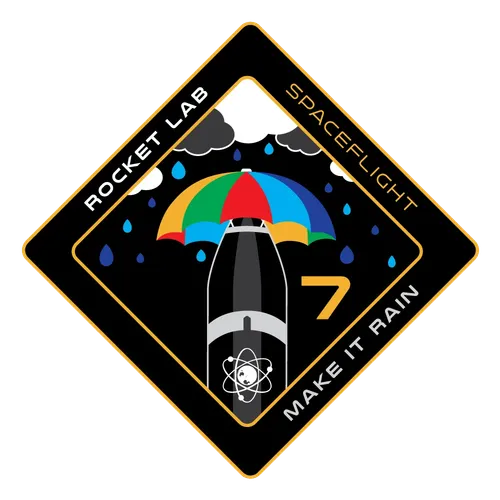
Make It Rain
Make It Rain was a Rocket Lab Electron mission for Spaceflight that launched successfully at 04:30 UTC on 29 June 2019 (4:30 p.m. NZST on 29 June; 12:30 a.m. EDT on 29 June) from Launch Complex 1A on New Zealand's Mahia Peninsula.
04:30 UTC on 29 June 2019 · 4:30 p.m. NZST on 29 June · 12:30 a.m. EDT on 29 June
Mission State
This mission currently has a dated launch window in the tracker.
The primary watch link points to an official Rocket Lab source.
Name Origin
Named for the rainy climates of Seattle (home of mission manager Spaceflight Inc.) and New Zealand's Mahia Peninsula launch site. A weather-based pun, not the "make it rain" money idiom.
Mission Overview
Rideshare mission for Spaceflight. Electron will launch seven spacecraft, including a commercial Earth-observing microsatellite for BlackSky, two CubeSats for U.S. Special Operations Command, a pair of tiny prototype data relay nodes for Swarm Technologies, a student-built payload from Australia called ACRUX-1, and a satellite whose identity and owner remain a secret. The mission is named "Make it Rain" in a nod to the high volume of rainfall in Seattle, where Spaceflight is headquartered, as well in New Zealand where Launch Complex 1 is located.
Technical Details
 32
kiwis
- Make It Rain rocketlabusa.com
Launch data cross-checked against Wikipedia.
Was this a jellyfish launch?
UnlikelySun 3° above the horizon at liftoff — daylight, the sky is too bright.
Details
- Unlikely
- Low
- Moderate
- High
- Liftoff
- 4:30 p.m. NZST · 04:30 UTC
- Sunset
- 4:54 p.m. NZST · 04:54 UTC
- Civil dusk (−6°)
- 5:24 p.m. NZST · 05:24 UTC
- Nautical dusk (−12°)
- 5:58 p.m. NZST · 05:58 UTC
- Astronomical dusk (−18°)
- 6:31 p.m. NZST · 06:31 UTC
Twilight times at the pad (Mahia, NZ) for the evening of the launch.
What's a rocket jellyfish? When a rocket launches in twilight, the ground is dark but its exhaust plume climbs into sunlight high above. The expanding plume glows against the dark sky in a jellyfish-like shape.
Space-Object Catalog
| Object | Operator | Built by | Mass | Orbit | Status | NORAD |
|---|---|---|---|---|---|---|
PAINANI-1 2019-037A · Payload | Operator Secreteria de la Defensa Nacional | Built by Universidad del Ejercito y Fuerza Aerea Mexicanos Cubesat 3U | Mass 4 kg | Orbit 146 × 155 km · 45.0° | Status Decayed 2023-01-13 | NORAD 44365 |
Prometheus 2.9 2019-037B · Payload | Operator US Special Operations Command | Built by Los Alamos National Laboratory Cubesat 1.5U | Mass 2 kg | Orbit 160 × 176 km · 45.0° | Status Decayed 2022-06-06 | NORAD 44366 |
Global-3 2019-037C · Payload | Operator BlackSky Global | Built by LeoStella LLC (SFLIN/THALES) BSky | Mass 55 kg | Orbit 164 × 176 km · 45.0° | Status Decayed 2023-05-15 | NORAD 44367 |
Electron 7 Kick Stage 2019-037D · Stage | Operator Rocket Lab Ltd. | Built by Rocket Lab Ltd. Kick Stage | Mass 50 kg | Orbit 220 × 243 km · 45.0° | Status Decayed 2022-04-14 | NORAD 44368 |
ACRUX 1 2019-037E · Payload | Operator Melbourne University | Built by Melbourne University Cubesat 1U | Mass 1 kg | Orbit 189 × 210 km · 45.0° | Status Decayed 2022-06-17 | NORAD 44369 |
SpaceBEE 9 2019-037F · Payload | Operator Swarm Technologies | Built by Swarm Technologies Cubesat 1U | Mass 1 kg | Orbit 171 × 183 km · 45.0° | Status Decayed 2021-12-16 | NORAD 44370 |
SpaceBEE 8 2019-037G · Payload | Operator Swarm Technologies | Built by Swarm Technologies Cubesat 1U | Mass 1 kg | Orbit 220 × 226 km · 45.0° | Status Decayed 2021-04-26 | NORAD 44371 |
Electron 7 Stage 2 2019-037H · Stage | Operator Rocket Lab Ltd. | Built by Rocket Lab Ltd. Electron St2 | Mass 250 kg | Orbit 163 × 174 km · 45.0° | Status Decayed 2020-03-16 | NORAD 44372 |
deb Electron Stage 2 2019-037J · Debris | Operator Rocket Lab Ltd. | Built by Rocket Lab Ltd. | Mass 0 kg | Orbit 275 × 383 km · 45.0° | Status Decayed 2019-07-02 | NORAD 44373 |
Prometheus 2.7 2019-037K · Payload | Operator US Special Operations Command | Built by Los Alamos National Laboratory Cubesat 1.5U | Mass 2 kg | Orbit 224 × 234 km · 45.0° | Status Decayed 2022-05-20 | NORAD 44374 |