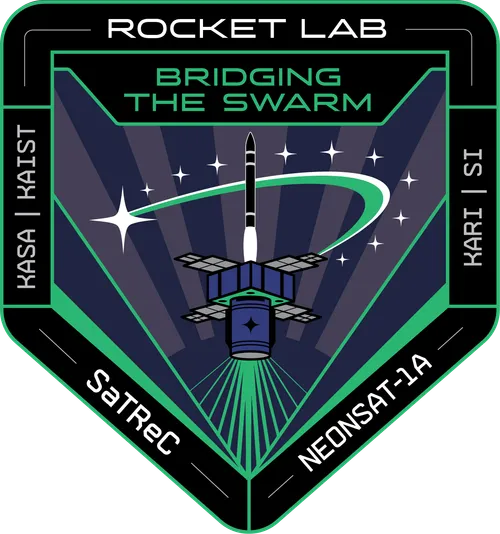
Bridging The Swarm
Bridging The Swarm was a Rocket Lab Electron mission for KAIST that launched successfully at 01:21 UTC on 30 January 2026 (2:21 p.m. NZDT on 30 January; 8:21 p.m. EST on 29 January) from Launch Complex 1A on New Zealand's Mahia Peninsula.
01:21 UTC on 30 January 2026 · 2:21 p.m. NZDT on 30 January · 8:21 p.m. EST on 29 January
Mission State
This mission currently has a dated launch window in the tracker.
The primary watch link points to an official Rocket Lab source.
Launch Updates
-
Launch success.
by Cosmic_Penguin Source: en.yna.co.kr -
Spacecraft separation.
by Cosmic_Penguin Source: youtube.com -
Official Webcast by Rocket Lab has started
by LL2 Source: youtube.com
Updates via Launch Library 2 (The Space Devs).
Name Origin
Sequel to "Beginning Of The Swarm" (Apr 2024, NeonSat-1) — NeonSat-1A "bridges" the single prototype satellite to the planned 10-satellite NeonSat constellation for KAIST.
Mission Overview
The NeonSat-1A, carrying a high-resolution optical camera, is designed to test the constellation capabilities of the South Korean government's Earth observation micro-satellite constellation NeonSat (New-space Earth Observation Satellite), in particular technology improvements identified from operations of NeonSat-1 after its launch in April 2024. These technologies will in turn be incorporated into the next 10 NeonSat under construction, as well as providing more site re-visiting capabilities along with NeonSat-1. The NeonSat constellation is the first satellite system developed by the government using a mass-production approach for precise monitoring of the Korean Peninsula, lead by the Satellite Technology Research Center (SaTReC) at the Korea Advanced Institute of Science and Technology (KAIST), Korea’s leading university dedicated to science and technology. Designed to capture near-real time natural disaster monitoring for the Korean peninsula, KAIST’s NEONSAT constellation is a collaboration across multiple Korean academic, industry, and research institutions, including SaTReC, which is leading the program’s system design and engineering. The NEONSAT program is funded by the Korean government’s Ministry of Science and ICT (MSIT).
In the news
- Rocket Lab Electron rocket aborts liftoff at engine ignition (opens in a new tab) Spaceflight Now
Electron's "Bridging the Swarm" mission aborted at ignition due to a sensor anomaly. Sensors performed as designed. Rocket Lab plans a rapid fix to maintain its ambitious triple-launch December schedule.
Technical Details
 40
kiwis
- Bridging The Swarm rocketlabcorp.com
Launch data cross-checked against Wikipedia.
Was this a jellyfish launch?
UnlikelySun 65° above the horizon at liftoff — daylight, the sky is too bright.
Details
- Unlikely
- Low
- Moderate
- High
- Liftoff
- 2:21 p.m. NZDT · 01:21 UTC
- Sunset
- 8:26 p.m. NZDT · 07:26 UTC
- Civil dusk (−6°)
- 8:56 p.m. NZDT · 07:56 UTC
- Nautical dusk (−12°)
- 9:32 p.m. NZDT · 08:32 UTC
- Astronomical dusk (−18°)
- 10:12 p.m. NZDT · 09:12 UTC
Twilight times at the pad (Mahia, NZ) for the evening of the launch.
What's a rocket jellyfish? When a rocket launches in twilight, the ground is dark but its exhaust plume climbs into sunlight high above. The expanding plume glows against the dark sky in a jellyfish-like shape.
Space-Object Catalog
| Object | Operator | Built by | Mass | Orbit | Status | NORAD |
|---|---|---|---|---|---|---|
Neonsat-1A 2026-019A · Payload | Operator Hanguk gwahag gisul-won | Built by Hanguk gwahag gisul-won / Hanwha SatRec Initiative Neonsat | Mass 100 kg | Orbit 529 × 549 km · 97.4° | Status On orbit | NORAD 67614 |
Electron 81 Stage 2 2026-019B · Stage | Operator Rocket Lab Ltd. | Built by Rocket Lab Ltd. Electron St2 | Mass 250 kg | Orbit 148 × 203 km · 97.4° | Status Decayed 2026-02-11 | NORAD 67615 |
Electron 81 Kick Stage 2026-019C · Stage | Operator Rocket Lab Ltd. | Built by Rocket Lab Ltd. Kick Stage | Mass 50 kg | Orbit 152 × 178 km · 97.4° | Status Decayed 2026-03-18 | NORAD 67616 |