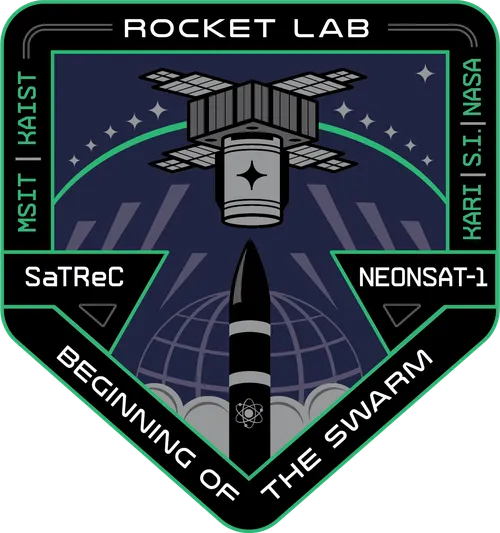
Beginning Of The Swarm
Beginning Of The Swarm was a Rocket Lab Electron mission for KAIST that launched successfully at 22:32 UTC on 23 April 2024 (10:32 a.m. NZST on 24 April; 6:32 p.m. EDT on 23 April) from Launch Complex 1B on New Zealand's Mahia Peninsula.
22:32 UTC on 23 April 2024 · 10:32 a.m. NZST on 24 April · 6:32 p.m. EDT on 23 April
Disclaimer: This livestream is from a third-party channel and is not an official Rocket Lab broadcast.
Mission State
This mission currently has a dated launch window in the tracker.
The current watch link is from a third-party source rather than Rocket Lab directly.
Launch Updates
-
Launch success.
by Cosmic_Penguin Source: en.yna.co.kr -
Both payloads have been deployed.
by Cosmic_Penguin Source: twitter.com -
Liftoff.
by Cosmic_Penguin Source: youtube.com
Updates via Launch Library 2 (The Space Devs).
Name Origin
This name marks the initial launch of multiple satellites, including ACS3 and NeonSat-1, heralding the commencement of a coordinated satellite constellation or technological initiative.
Mission Overview
NASA's Advanced Composite Solar Sail System (ACS3) is a technology demonstration mission tasked with deploying a composite boom solar sail. NeonSat-1 is a high-resolution optical satellite by South Korea's KAIST that will be deployed as a technology demonstration for a planned future Earth observation constellation.
Technical Details
 46
kiwis
Launch data cross-checked against Wikipedia.
Was this a jellyfish launch?
UnlikelySun 33° above the horizon at liftoff — daylight, the sky is too bright.
Details
- Unlikely
- Low
- Moderate
- High
- Liftoff
- 10:32 a.m. NZST · 22:32 UTC
- Astronomical dawn (−18°)
- 5:15 a.m. NZST · 17:15 UTC
- Nautical dawn (−12°)
- 5:46 a.m. NZST · 17:46 UTC
- Civil dawn (−6°)
- 6:17 a.m. NZST · 18:17 UTC
- Sunrise
- 6:45 a.m. NZST · 18:45 UTC
Twilight times at the pad (Mahia, NZ) for the morning of the launch.
What's a rocket jellyfish? When a rocket launches in twilight, the ground is dark but its exhaust plume climbs into sunlight high above. The expanding plume glows against the dark sky in a jellyfish-like shape.
Space-Object Catalog
| Object | Operator | Built by | Mass | Orbit | Status | NORAD |
|---|---|---|---|---|---|---|
Neonsat-1 2024-077A · Payload | Operator Hanguk gwahag gisul-won | Built by Hanguk gwahag gisul-won / Hanwha SatRec Initiative Neonsat | Mass 100 kg | Orbit 438 × 447 km · 97.3° | Status On orbit | NORAD 59587 |
ACS3 2024-077B · Payload | Operator NASA Ames Research Center, Moffett Field | Built by NASA Ames Research Center, Moffett Field / NanoAvionics US Cubesat 12U | Mass 16.1 kg | Orbit 861 × 936 km · 97.3° | Status On orbit | NORAD 59588 |
Electron 47 Stage 2 2024-077C · Stage | Operator Rocket Lab Ltd. | Built by Rocket Lab Ltd. Electron St2 | Mass 250 kg | Orbit 128 × 193 km · 97.4° | Status Decayed 2024-04-29 | NORAD 59589 |
Electron 47 Kick Stage 2024-077D · Stage | Operator Rocket Lab Ltd. | Built by Rocket Lab Ltd. Kick Stage | Mass 50 kg | Orbit 455 × 937 km · 97.3° | Status On orbit | NORAD 59590 |
