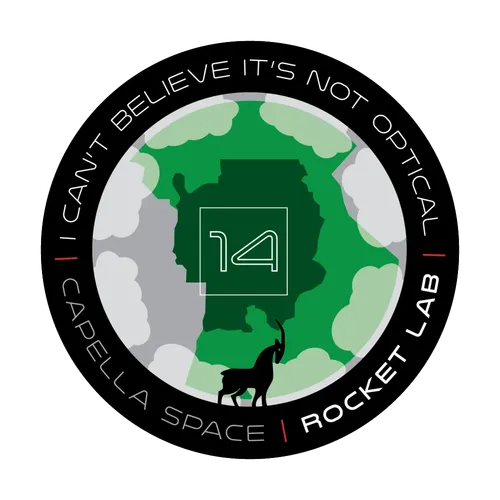
I Can’t Believe It’s Not Optical
I Can’t Believe It’s Not Optical was a Rocket Lab Electron mission for Capella that launched successfully at 03:05 UTC on 31 August 2020 (3:05 p.m. NZST on 31 August; 11:05 p.m. EDT on 30 August) from Launch Complex 1A on New Zealand's Mahia Peninsula.
03:05 UTC on 31 August 2020 · 3:05 p.m. NZST on 31 August · 11:05 p.m. EDT on 30 August
Mission State
This mission currently has a dated launch window in the tracker.
The primary watch link points to an official Rocket Lab source.
Name Origin
A playful nod to the "I Can't Believe It's Not Butter!" brand, this name highlights the surprising clarity and capability of Capella Space's non-optical Synthetic Aperture Radar (SAR) satellites.
Mission Overview
This return to flight mission is dedicated for Capella Space, an information services company providing Earth observation data on demand. Capella’s payload, ‘Sequoia’, is a single 100 kg class microsatellite which will be the first publicly available satellite in the company’s commercial Synthetic Aperture Radar (SAR) constellation. By positioning the satellite to a 45-degree inclination, Capella Space will maximize coverage over important areas such as the Middle East, Korea, Japan, Europe, South East Asia, Africa, and the U.S. The mission name is a nod to Capella’s SAR technology that provides high quality images of the Earth day or night, and in any weather conditions, as well as a nod to the infamous advertisement campaign for “I Can’t Believe It’s Not Butter”. Capella’s space-based radar can detect sub-0.5 meter changes on the surface of the Earth, providing insights and data that can be used for security, agricultural and infrastructure monitoring, as well as disaster response and recovery.
Technical Details
 40
kiwis
- I Can't Believe It's Not Optical rocketlabusa.com
Launch data cross-checked against Wikipedia.
Was this a jellyfish launch?
UnlikelySun 27° above the horizon at liftoff — daylight, the sky is too bright.
Details
- Unlikely
- Low
- Moderate
- High
- Liftoff
- 3:05 p.m. NZST · 03:05 UTC
- Sunset
- 5:45 p.m. NZST · 05:45 UTC
- Civil dusk (−6°)
- 6:12 p.m. NZST · 06:12 UTC
- Nautical dusk (−12°)
- 6:43 p.m. NZST · 06:43 UTC
- Astronomical dusk (−18°)
- 7:14 p.m. NZST · 07:14 UTC
Twilight times at the pad (Mahia, NZ) for the evening of the launch.
What's a rocket jellyfish? When a rocket launches in twilight, the ground is dark but its exhaust plume climbs into sunlight high above. The expanding plume glows against the dark sky in a jellyfish-like shape.
Space-Object Catalog
| Object | Operator | Built by | Mass | Orbit | Status | NORAD |
|---|---|---|---|---|---|---|
First Light 2020-060A · Payload | Operator Rocket Lab Ltd. | Built by Rocket Lab Ltd. Photon | Mass 20 kg | Orbit 158 × 163 km · 45.0° | Status Decayed 2025-01-19 | NORAD 46268 |
Sequoia 2020-060B · Payload | Operator Capella Space Corp. | Built by Capella Space Corp. Sequoia | Mass 100 kg | Orbit 205 × 216 km · 45.1° | Status Decayed 2023-02-28 | NORAD 46269 |
Electron 14 Stage 2 2020-060C · Stage | Operator Rocket Lab Ltd. | Built by Rocket Lab Ltd. Electron St2 | Mass 250 kg | Orbit 136 × 180 km · 45.1° | Status Decayed 2020-09-19 | NORAD 46270 |