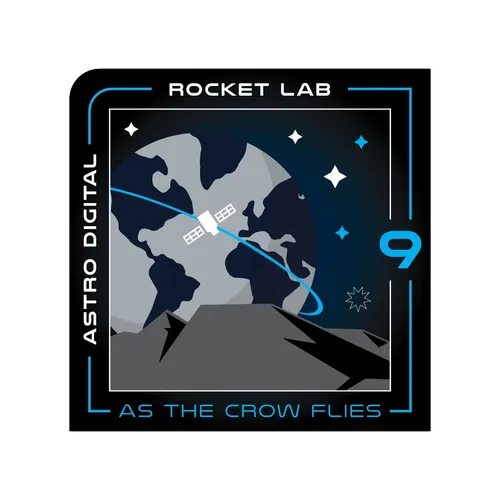
As The Crow Flies
As The Crow Flies was a Rocket Lab Electron mission for Astro Digital that launched successfully at 01:22 UTC on 17 October 2019 (2:22 p.m. NZDT on 17 October; 9:22 p.m. EDT on 16 October) from Launch Complex 1A on New Zealand's Mahia Peninsula.
01:22 UTC on 17 October 2019 · 2:22 p.m. NZDT on 17 October · 9:22 p.m. EDT on 16 October
Disclaimer: This livestream is from a third-party channel and is not an official Rocket Lab broadcast.
Mission State
This mission currently has a dated launch window in the tracker.
The current watch link is from a third-party source rather than Rocket Lab directly.
Name Origin
Puns on Astro Digital's "Corvus" satellite platform (corvus = Latin for crow) while the idiom "as the crow flies" (most direct route) fits the dedicated mission profile.
Mission Overview
Encapsulated in Electron's fairing will be a single spacecraft for Astro Digital, a California-based satellite manufacturer and operator. The Landmapper-BC remote sensing satellite features a broad coverage multispectral imaging system with a resolution of 22 meters per pixel. Eventually, Astro Digital plans to extend the Landmapper-BC constellation to capture daily, multispectral imagery of the world’s arable land. The mission is named 'As The Crow Flies' in a nod to Astro Digital's Corvus Platform, which provides flexible and cost-effective solutions across a wide range of applications and mission profiles on bus variants ranging from 6U and 16U CubeSats to ESPA Class. Corvus is also a widely-distributed genus of birds which includes crows.
Technical Details
 8
kiwis
- As The Crow Flies rocketlabusa.com
Launch data cross-checked against Wikipedia.
Was this a jellyfish launch?
UnlikelySun 54° above the horizon at liftoff — daylight, the sky is too bright.
Details
- Unlikely
- Low
- Moderate
- High
- Liftoff
- 2:22 p.m. NZDT · 01:22 UTC
- Sunset
- 7:28 p.m. NZDT · 06:28 UTC
- Civil dusk (−6°)
- 7:56 p.m. NZDT · 06:56 UTC
- Nautical dusk (−12°)
- 8:29 p.m. NZDT · 07:29 UTC
- Astronomical dusk (−18°)
- 9:03 p.m. NZDT · 08:03 UTC
Twilight times at the pad (Mahia, NZ) for the evening of the launch.
What's a rocket jellyfish? When a rocket launches in twilight, the ground is dark but its exhaust plume climbs into sunlight high above. The expanding plume glows against the dark sky in a jellyfish-like shape.
Space-Object Catalog
| Object | Operator | Built by | Mass | Orbit | Status | NORAD |
|---|---|---|---|---|---|---|
Palisade 2019-069A · Payload | Operator Astro Digital | Built by Astro Digital Cubesat 16U | Mass 40 kg | Orbit 1,207 × 1,224 km · 87.9° | Status On orbit | NORAD 44634 |
Electron 9 Stage 2 2019-069B · Stage | Operator Rocket Lab Ltd. | Built by Rocket Lab Ltd. Electron St2 | Mass 250 kg | Orbit 130 × 166 km · 87.8° | Status Decayed 2023-09-13 | NORAD 44635 |
Electron 9 Kick Stage 2019-069C · Stage | Operator Rocket Lab Ltd. | Built by Rocket Lab Ltd. Kick Stage | Mass 40 kg | Orbit 478 × 1,096 km · 87.9° | Status On orbit | NORAD 44636 |
deb Palisade? 2019-069D · Debris | Operator Astro Digital | Built by Astro Digital | Mass 0 kg | Orbit 313 × 1,088 km · 87.9° | Status Decayed 2019-12-14 | NORAD 44639 |