Customer Profile
JAXA
Japan Aerospace Exploration Agency
The Japan Aerospace Exploration Agency (JAXA) is a national space agency founded on **October 1, 2003** 12. The organization manages diverse space activities including rocket development, satellite missions, and lunar exploration 12.
JAXA operates several launch vehicle series including the **H3, H-IIA, H-IIB, and Epsilon** 1. The agency maintains a significant annual budget, reaching **¥215.5 billion ($1.46 billion)** in FY2023 3.
Investment Thesis
The Japan Aerospace Exploration Agency (JAXA) is a national space agency founded on **October 1, 2003** 12. The organization manages diverse space activities including rocket development, satellite missions, and lunar exploration 12.
JAXA operates several launch vehicle series including the **H3, H-IIA, H-IIB, and Epsilon** 1. The agency maintains a significant annual budget, reaching **¥215.5 billion ($1.46 billion)** in FY2023 3.
Key Differentiators
- • Diverse Launch Portfolio: JAXA operates its own launch vehicles including the **H3, H-IIA, H-IIB, and Epsilon** series 1.
- • Extensive Mission History: The agency has executed complex missions such as **Hayabusa, Hayabusa2, SELENE (Kaguya), and SLIM** 1.
- • Large-Scale Funding: JAXA utilized an annual budget of **¥215.5 billion ($1.46 billion)** for FY2023 3.
Risk Factors
- • Budgetary Constraints: Agency operations are subject to annual budget allocations, with the FY2023 budget recorded at **¥215.5 billion** 3.
- • Complex Mission Execution: Managing diverse programs ranging from **ISS modules (Kibō)** to interplanetary missions like **BepiColombo** requires high operational continuity 1.
Rocket Lab Relationship
JAXA is a verified Rocket Lab customer with **2 successful Electron launches** . These include the **Kakushin Rising (JAXA Rideshare)** mission in April 2026 and the **Raise and Shine (RAISE-4)** mission in December 2025 .
These missions utilize the **Electron** launch service for **Sun-Synchronous Orbit** deployments . This relationship provides recurring revenue for Rocket Lab's **Launch Services** segment and validates the Electron's capability to meet the requirements of a major national space agency .
Business Model
JAXA is a government agency funded through national budgets, recording **¥215.5 billion ($1.46 billion)** for FY2023 3.
Technology
Key technologies include launch vehicles like the **H-II series** and space-based assets such as the **Kibō ISS module** and **HTV-X** transfer vehicles 1.
Leadership
Hiroshi Yamakawa, President
Hiroshi Yamakawa, President. (Note: Previous presidents include Shūichirō Yamanouchi, Keiji Tachikawa, and Naoki Okumura).
Funding
JAXA operates with an annual budget of **¥215.5 billion ($1.46 billion)** for FY2023 3.
Launch History
Rocket Lab mission record for JAXA
Most recent completed flight: Kakushin Rising on Apr 23, 2026.
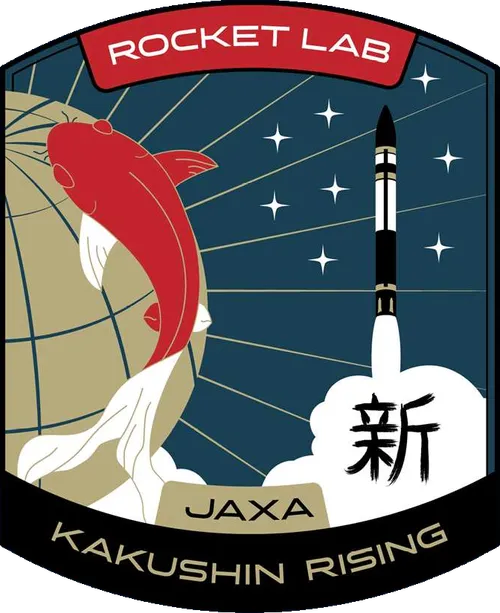
Kakushin Rising
Open the mission profile for patch, manifest, and vehicle detail.

Raise and Shine
Open the mission profile for patch, manifest, and vehicle detail.